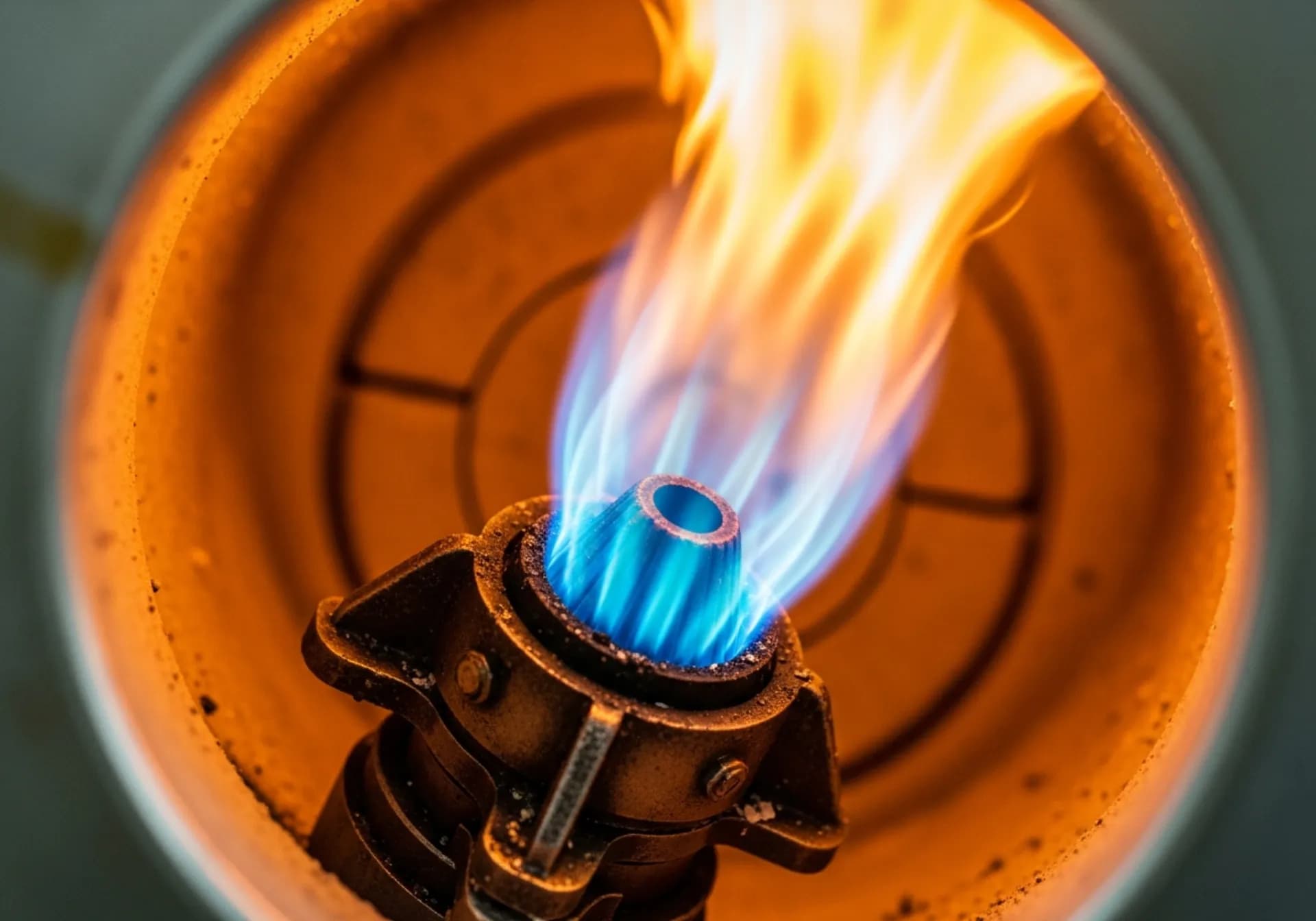
Falcon Environmental Solutions provides expert burner tuning services for pollution control equipment, process heaters, and boilers. Our combustion specialists optimize fuel-air ratios, reduce emissions, and improve thermal efficiency on John Zink, Zeeco, Alzeta, Maxon, Eclipse, and other major burner systems installed at industrial facilities across the country.
Combustion optimization is one of the most impactful services a pollution control equipment company can provide. A properly tuned burner delivers lower fuel costs, reduced emissions, longer refractory life, and more consistent process temperatures. A poorly tuned burner wastes fuel, produces excess NOx and CO, accelerates wear on downstream components, and puts your facility at risk of regulatory violations. Falcon Environmental Solutions employs combustion specialists with hands-on experience tuning burners on thermal oxidizers, regenerative thermal oxidizers (RTOs), catalytic oxidizers, direct-fired process heaters, and industrial boilers across a wide range of industries including petrochemical, pharmaceutical, food and beverage, printing, coating, and chemical manufacturing.
Our burner tuning process begins with a thorough baseline assessment of the combustion system. Technicians arrive on site with portable combustion analyzers capable of measuring O2, CO, CO2, NOx, and combustion efficiency simultaneously. We record baseline readings at multiple firing rates, from minimum fire through maximum fire, documenting the existing fuel-air curve and identifying any deviations from manufacturer specifications. We inspect the burner assembly, fuel train components, combustion air supply, and flame monitoring equipment before making any adjustments. This data-driven baseline ensures we know exactly where the system stands before we change a single setting.
Fuel-air ratio optimization is the core of every burner tuning engagement. Excess air is the primary driver of both fuel waste and thermal inefficiency. Running a burner with too much excess air dilutes the combustion products, lowers the flame temperature, and forces the system to heat unnecessary volumes of nitrogen that pass straight through the process and out the stack. Running with too little air produces incomplete combustion, generating carbon monoxide and unburned hydrocarbons while creating safety risks. Our technicians dial in the optimal excess air level at every firing rate, typically targeting 2-3% O2 in the flue gas for natural gas burners. This precision work can reduce fuel consumption by 5-15% depending on how far the system has drifted from optimal conditions.
NOx reduction is increasingly important as state and federal regulations tighten. Many of the thermal oxidizers and process heaters we service are equipped with low-NOx burner technology from manufacturers like John Zink (LNZE, COOLstar), Zeeco (GLSF, Ultra Low NOx), and Alzeta (CSB surface-stabilized burners). These burners achieve low NOx through staged combustion, flue gas recirculation (FGR), or surface-stabilized combustion techniques, but they only deliver their rated NOx performance when properly tuned. Our technicians are trained on the specific tuning procedures for each burner family and understand how to balance NOx performance against CO emissions, flame stability, and turndown capability.
Flame stability and turndown performance determine how reliably a burner operates across its full operating range. Industrial processes rarely operate at a single fixed firing rate. Thermal oxidizers modulate to match varying VOC loads. Process heaters ramp up and down with batch cycles. Boilers follow steam demand curves. The burner must maintain a stable, well-shaped flame from minimum fire to maximum fire without lifting, flashback, resonance, or flame-out. Our tuning process verifies stable operation at every point in the firing range, with particular attention to the transition zones where combustion instability is most likely. We adjust air register positions, gas pressure regulators, and linkage settings to ensure smooth, stable modulation throughout the entire range.
Pilot systems and ignition systems are the front line of burner reliability. A failed pilot or ignition system means the burner cannot start, which means your thermal oxidizer or heater is offline until a technician arrives. We inspect and tune pilot assemblies, verify spark ignitor gap and energy, test flame rod signal strength and UV scanner sensitivity, and confirm proper pilot proving times per NFPA 86 requirements. For systems with direct spark ignition (DSI) rather than continuous pilots, we verify the ignition sequence timing and confirm reliable lightoff across the expected range of ambient conditions.
Flame safety systems protect personnel and equipment from the catastrophic consequences of uncontrolled fuel release. During every burner tuning engagement, our technicians verify the complete flame safety sequence: pre-purge timing, pilot trial for ignition, main flame trial for ignition, running interlock monitoring, and post-purge. We test safety shutoff valve (SSOV) leak tightness using the pressure decay method specified in NFPA 86. We verify that the burner management system (BMS) or flame safety controller properly detects loss of flame and initiates a safety shutdown within the required response time. This testing protects your facility and also satisfies the inspection requirements that insurance carriers and regulatory agencies enforce.
EPA and TCEQ compliance is a driving factor behind most burner tuning engagements. Air permits typically specify maximum emission rates for NOx, CO, and VOCs from combustion equipment. Thermal oxidizers have destruction rate efficiency (DRE) requirements that depend directly on combustion temperature and residence time, both of which are affected by burner performance. When a source test shows marginal compliance or a regulatory inspection identifies combustion issues, burner tuning is often the fastest and most cost-effective path back to full compliance. We provide detailed tuning reports documenting pre-tuning and post-tuning emissions data, fuel consumption rates, and combustion efficiency metrics that you can include in your compliance records.
Ongoing burner maintenance programs extend the value of a tuning engagement well beyond the initial site visit. Combustion systems drift over time as orifices wear, linkages loosen, refractory degrades, and fuel composition varies. Falcon Environmental Solutions offers scheduled burner maintenance programs that include quarterly or semi-annual tuning visits, combustion analysis, pilot system inspection, flame safety testing, and fuel train leak checks. These recurring visits catch drift early, maintain peak efficiency, and ensure your combustion equipment stays in compliance between source tests. Clients who participate in our maintenance programs consistently report lower fuel costs, fewer unplanned shutdowns, and smoother regulatory interactions than facilities that only call for service when something breaks.
We service burners from every major manufacturer in the pollution control industry. John Zink Hamworthy burners are found on a large percentage of the thermal oxidizers and process heaters operating in the Gulf Coast petrochemical corridor and across the country. Zeeco burners are common on flare systems, thermal oxidizers, and process heaters in refining and gas processing. Maxon and Eclipse burners appear frequently on smaller industrial process heaters, ovens, and furnaces. Alzeta surface-stabilized burners are used in applications requiring ultra-low NOx performance. Regardless of the manufacturer, our technicians have the training and field experience to tune the burner to its rated performance specifications.
Burner tuning follows manufacturer-specific procedures for each burner family and references NFPA 86 (Standard for Ovens and Furnaces) for flame safety system requirements. Combustion analysis uses calibrated portable analyzers measuring O2 (0-25%), CO (0-10,000 ppm), CO2, and NOx (0-1,000 ppm) with NIST-traceable calibration gas verification. Fuel-air ratio optimization targets 2-3% O2 in flue gas for natural gas at full fire, with appropriate excess air curves across the turndown range. NOx tuning on low-NOx burners follows staged combustion and FGR adjustment procedures specific to each manufacturer (John Zink LNZE, Zeeco GLSF, Alzeta CSB). SSOV leak testing per NFPA 86 Chapter 8 uses pressure decay method with documented pass/fail criteria. Flame rod microamp signal strength verified at minimum 2 microamps DC with recommended 4+ microamps. UV scanner response time verified per manufacturer specifications, typically under 4 seconds for flame failure detection.
Contact us to discuss your burner tuning requirements and get a tailored proposal for your facility.
Request a QuoteNFPA Inspections
NFPA 86 compliance inspections for thermal oxidizers, ovens, furnaces, and all Class A and Class B fuel-fired equipment, with complete documentation for insurance carriers and regulatory agencies.
System Upgrades
Piping, ductwork, valve, burner, refractory, damper, fan, and insulation upgrades for thermal oxidizers, RTOs, scrubbers, and other pollution control equipment.
Environmental Consulting & Permit Support
Air permit applications, emissions inventory, regulatory compliance strategy, and agency coordination for facilities operating pollution control equipment under EPA, TCEQ, and state regulatory programs.
Engineered for Reliability. Built for the Field.
Why industrial facilities nationwide choose Falcon Environmental Solutions for burner tuning services.
Optimized fuel-air ratios eliminate excess air that wastes fuel heating unnecessary nitrogen. Most facilities see 5-15% fuel savings after a professional burner tune, which translates to thousands of dollars annually on high-firing-rate equipment.
Precision tuning keeps emissions within permit limits and often well below them. For facilities in ozone nonattainment areas with strict NOx limits, proper burner tuning is essential to maintaining compliance without costly hardware upgrades.
A well-tuned burner maintains a stable flame across its full turndown range. This eliminates nuisance shutdowns caused by flame instability during load changes, reducing unplanned downtime and operator intervention.
Proper combustion reduces thermal stress on refractory linings, heat exchangers, and catalyst beds. Equipment that runs at the correct temperature and air-fuel balance lasts significantly longer between major repairs.
Documented tuning reports provide evidence of proper combustion management for EPA, TCEQ, and insurance inspectors. Proactive tuning avoids the enforcement actions and penalties that follow failed source tests.
Verified flame safety sequences and tested safety shutoff valves protect your facility and personnel. Proper flame safety system operation is required by NFPA 86 and is a primary focus of insurance inspections.
Our burner tuning services support a wide range of industrial and environmental applications.
Main burners and auxiliary burners on direct-fired thermal oxidizers, regenerative thermal oxidizers (RTOs), and recuperative thermal oxidizers require precise tuning to maintain destruction rate efficiency (DRE) and meet air permit emission limits.
Fired heaters in refining, petrochemical, and chemical manufacturing rely on properly tuned burners for consistent heat delivery, fuel efficiency, and compliance with MACT/NESHAP requirements for process heaters.
Fire-tube and water-tube boilers across all industries benefit from combustion optimization that reduces fuel waste, lowers NOx to meet Boiler MACT (40 CFR 63 Subpart DDDDD) requirements, and improves steam generation efficiency.
Preheat burners on catalytic oxidizer systems must deliver stable, uniform heat to bring the catalyst bed to operating temperature without thermal shock, while maintaining low emissions during the warmup cycle.
Flare system pilots must remain lit in all weather conditions. Tuning and verification of pilot flame stability, ignitor performance, and thermocouple response ensures continuous flare readiness per 40 CFR 60.18 and 40 CFR 63.11 requirements.
Falcon Environmental Solutions delivers burner tuning services engineered for reliability, compliance, and long-term operational value. Contact us to discuss your project requirements and receive a detailed engineering proposal.