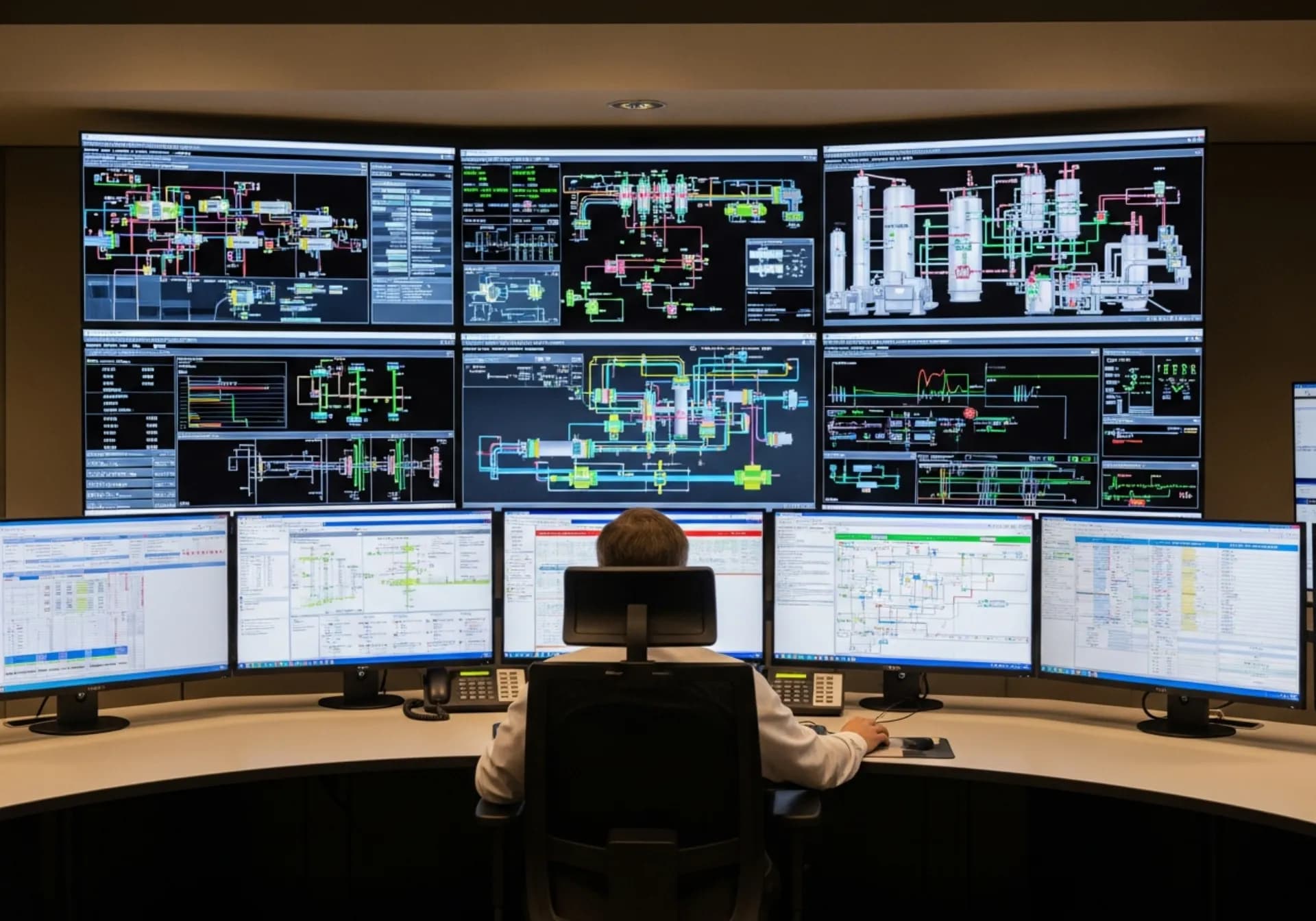
FalconWatch is Falcon Environmental Solutions' remote monitoring service for pollution control equipment, built on a platform developed by our industry partner Creekmist Controls. FalconWatch provides 24/7 equipment visibility, automated compliance reporting, alarm management, and secure portal access for thermal oxidizers, RTOs, scrubbers, and other environmental control systems.
Pollution control equipment runs around the clock, but your operations team cannot be on site 24 hours a day. When a thermal oxidizer trips offline at 2:00 AM, you need to know about it immediately, not when the day shift arrives and finds a cold chamber. When a scrubber's recirculation pump fails on a Saturday, the emissions exceedance is already happening by the time anyone notices on Monday. When an RTO's pressure drop creeps up gradually over weeks, the trend is invisible to operators who only see the current value on a local display. FalconWatch is the remote monitoring service that closes these gaps, giving you continuous visibility into your pollution control equipment from any device, anywhere, at any time.
The FalconWatch platform was developed by our industry partner Creekmist Controls, a company that specializes in industrial automation and SCADA systems for environmental and process equipment. Creekmist Controls built FalconWatch on Ignition by Inductive Automation, a proven industrial SCADA platform used by thousands of facilities worldwide. Falcon Environmental Solutions offers FalconWatch as a monitoring service to our clients. Creekmist Controls maintains and develops the platform. This partnership leverages the strengths of both companies: Falcon's pollution control equipment expertise and client relationships, and Creekmist Controls' automation engineering and software development capabilities.
Real-time equipment status monitoring provides continuous visibility into every critical operating parameter on your pollution control equipment. For thermal oxidizers, FalconWatch displays combustion chamber temperature, process inlet and outlet temperatures, combustion airflow, fuel gas pressure, burner status, and safety interlock states. For RTOs, the display includes bed temperatures for each regenerative chamber, valve positions, cycle timing, pressure drop across the media beds, and thermal efficiency calculations. For scrubbers, the platform shows recirculation flow rates, pH levels, pressure drop, liquid levels, chemical feed rates, and mist eliminator differential pressure. Every parameter is displayed with its normal operating range clearly indicated so that abnormal conditions stand out immediately.
Alarm management ensures that the right people are notified about the right conditions at the right time. FalconWatch implements a structured alarm system with configurable priority levels, notification channels (email, SMS, voice call), and escalation logic. Critical alarms, such as equipment shutdown, flame failure, or high temperature, trigger immediate notification to designated responders. Warning alarms, such as parameter drift toward limits, elevated pressure drop, or minor equipment faults, generate notifications during business hours or are logged for review. Advisory alarms capture low-priority conditions that should be addressed during the next scheduled maintenance. Every alarm is logged with a timestamp, priority level, acknowledgment status, and return-to-normal record, creating a complete alarm history for compliance documentation and incident investigation.
Compliance data logging is one of the most valuable features FalconWatch provides. Air permits for pollution control equipment typically require continuous monitoring and recording of key operating parameters that demonstrate ongoing compliance. For thermal oxidizers, this commonly includes combustion chamber temperature recorded at intervals not exceeding 15 minutes. For scrubbers, this may include pH, pressure drop, and liquid flow rate. For catalytic oxidizers, this includes inlet temperature and pressure drop across the catalyst bed. FalconWatch logs all required parameters automatically at the required frequency, stores the data securely, and generates the compliance reports that your permit conditions specify. This automated approach eliminates the manual paper logs that consume operator time and introduce transcription errors.
Automated reporting transforms raw monitoring data into the formatted reports that facility managers, environmental compliance officers, and regulatory agencies need. Standard FalconWatch reports include daily operating summaries showing all monitored parameters with min/max/average values and any alarm events, monthly compliance reports formatted to match permit-specific reporting requirements, equipment runtime and availability reports for maintenance planning, and alarm performance reports that identify chronic alarm conditions requiring attention. Reports are generated automatically on schedule and delivered to designated recipients by email. Custom reports can be configured for specific regulatory or operational requirements.
Secure client portal access provides each authorized user with a web-based interface to their facility's monitoring data. The portal runs in any modern web browser on desktop computers, tablets, and smartphones. No special software installation is required. Each user sees only the equipment and data they are authorized to access, with role-based permissions that separate administrator functions from operator-level viewing. Facility managers see operational dashboards and summary reports. Environmental compliance officers see compliance data and regulatory reports. Maintenance technicians see equipment diagnostics and alarm histories. Corporate executives see high-level operational metrics across multiple facilities. All portal connections are encrypted, and access requires authentication through the secure login system.
Predictive maintenance insights leverage the continuous data stream from your pollution control equipment to identify developing problems before they cause failures. FalconWatch tracks trends in key performance indicators that signal equipment degradation: gradually increasing pressure drop across RTO heat exchange media indicates fouling or media breakdown. Rising combustion chamber shell temperature suggests refractory degradation. Declining thermal efficiency points to heat recovery system fouling. Increasing vibration signatures from fans and blowers warn of bearing wear. By monitoring these trends and alerting your maintenance team when parameters exceed baseline thresholds, FalconWatch enables planned corrective maintenance during scheduled outages rather than emergency repairs after an unplanned failure.
Multi-site visibility is essential for companies that operate pollution control equipment at multiple facilities. FalconWatch provides a unified view across all monitored sites, allowing operations managers and environmental compliance teams to see the status of every piece of monitored equipment from a single dashboard. Site-level dashboards drill down to individual equipment detail. Alarm summaries aggregate across all sites so that a single person monitoring the portfolio overnight can see every active alarm condition at every facility. This multi-site capability is particularly valuable for environmental service companies, multi-plant manufacturers, and organizations with distributed operations.
Connectivity and installation are managed to minimize impact on your facility's existing control systems. FalconWatch connects to your pollution control equipment's control system through a secure gateway device installed at your site. The gateway reads data from the PLC or control panel using standard industrial protocols (Modbus TCP, EtherNet/IP, OPC UA) and transmits it to the FalconWatch cloud infrastructure over an encrypted connection. The gateway is a read-only data collection device. It does not write to or control your equipment. This architecture ensures that FalconWatch cannot inadvertently affect your pollution control equipment's operation. Installation typically takes less than one day for a single piece of equipment and does not require a process shutdown.
Falcon Environmental Solutions offers FalconWatch as a managed monitoring service. We handle the subscription, onboarding, gateway installation, configuration, and ongoing support. When FalconWatch alerts identify an equipment issue that requires field service, our service team already has the monitoring data and alarm history, giving them a head start on diagnosis before they arrive on site. This integration between remote monitoring and field service is a distinct advantage of working with Falcon for both monitoring and maintenance. The monitoring and the people who respond to monitoring findings are part of the same organization, eliminating the communication gaps that occur when monitoring and service are provided by separate companies.
FalconWatch is built on Ignition by Inductive Automation, developed and maintained by Creekmist Controls. Data acquisition uses Ignition Edge gateways with store-and-forward capability for network resilience. Field communication protocols include Modbus TCP, EtherNet/IP, OPC UA, and MQTT. Data is transmitted to the FalconWatch cloud infrastructure over encrypted TLS connections via Tailscale VPN tunnels. Historical data storage uses SQL-based Tag Historian with configurable sample rates (1 second to 15 minutes) and retention periods (1 year to indefinite). Alarm management follows ISA-18.2 guidelines with configurable priority levels, notification channels, escalation logic, and shelving capabilities. Client portal uses Ignition Perspective for responsive web-based access across desktop, tablet, and mobile devices. Role-based access control enforces data isolation between client organizations. Gateway installation is read-only with no write access to the host control system.
Contact us to discuss your falconwatch remote monitoring requirements and get a tailored proposal for your facility.
Request a QuoteControls Upgrades
PLC, HMI, and safety system modernization for pollution control equipment, performed by our industry partners Creekmist Controls and MAK Solutions, with Falcon Environmental Solutions managing project coordination and equipment expertise.
Burner Tuning
Combustion optimization for thermal oxidizers, process heaters, and boilers, delivering lower NOx emissions, reduced fuel consumption, and reliable flame stability across all major burner platforms.
Source Testing Support
EPA reference method testing support including stack test coordination, test port installation, pre-test equipment verification, data review, and CEMS correlation for pollution control equipment compliance demonstrations.

Engineered for Reliability. Built for the Field.
Why industrial facilities nationwide choose Falcon Environmental Solutions for falconwatch remote monitoring services.
See the status of your pollution control equipment from any device at any time. Night shifts, weekends, holidays, and off-site locations no longer mean operating blind. Equipment issues are identified when they occur, not when someone happens to check.
FalconWatch logs every permit-required parameter automatically, eliminating manual paper logs. Automated compliance reports are generated on schedule and delivered without operator intervention. Your compliance records are complete, accurate, and available on demand.
Immediate alarm notifications mean equipment issues are addressed in minutes rather than hours. When an oxidizer trips offline overnight, the on-call technician knows before the emissions exceedance becomes a regulatory deviation report.
Predictive maintenance trending identifies developing problems while they are still minor. Planned repairs during scheduled maintenance windows are less expensive and less disruptive than emergency repairs after a failure.
When FalconWatch identifies an equipment issue, Falcon's field service team already has the data and alarm history. Diagnosis begins before the technician arrives on site. This integration between monitoring and service reduces response time and repair duration.
The FalconWatch gateway reads data from your control system without writing to it. Installation does not require a process shutdown. Your pollution control equipment continues operating normally throughout the setup process. Typical installation takes less than one day.
Our falconwatch remote monitoring services support a wide range of industrial and environmental applications.
Continuous monitoring of combustion temperature, airflow, burner status, and safety interlocks for direct-fired, recuperative, and regenerative thermal oxidizers, with automated logging of parameters required by air permits.
Real-time tracking of bed temperatures, valve cycling, pressure drop, and thermal efficiency for RTOs, with trend analysis that identifies media degradation, fouling, and mechanical wear before they cause performance failures.
Continuous monitoring of pH, recirculation flow, pressure drop, chemical feed rates, and liquid levels for wet and dry scrubber systems, with automated compliance data logging and alarm notification for parameter exceedances.
Unified monitoring dashboard for companies operating pollution control equipment at multiple locations, providing portfolio-wide visibility, centralized alarm management, and consolidated compliance reporting across all sites.
Monitoring of catalyst bed temperatures, inlet preheat, pressure drop, and destruction efficiency indicators for catalytic oxidizer systems, with trending that supports catalyst life prediction and replacement planning.
Falcon Environmental Solutions delivers falconwatch remote monitoring services engineered for reliability, compliance, and long-term operational value. Contact us to discuss your project requirements and receive a detailed engineering proposal.