Falcon Environmental Solutions provides complete new pollution control equipment construction services from initial engineering through commissioning and startup. We deliver thermal oxidizers, RTOs, catalytic oxidizers, scrubbers, and flare systems as turnkey projects, managing structural fabrication and pressure vessel work as part of the overall scope.
When your facility needs new pollution control equipment, whether driven by a new air permit requirement, an expansion project, a regulatory rule change, or replacement of equipment that has reached end of life, Falcon Environmental Solutions manages the entire project from concept through commissioning. New unit construction is the most complex service we provide, involving process engineering, mechanical design, structural design, fabrication, site preparation, installation, controls integration, and startup. Our turnkey approach puts a single point of responsibility over the entire project scope, eliminating the coordination gaps that occur when multiple independent contractors divide the work.
Thermal oxidizer construction covers the full range of oxidizer technologies used in pollution control. Direct-fired thermal oxidizers are the simplest configuration, using a burner to heat the process gas stream to the required destruction temperature (typically 1,400 to 1,800 degrees Fahrenheit) in a refractory-lined combustion chamber with sufficient residence time (typically 0.5 to 2.0 seconds) to destroy VOCs and HAPs to the required efficiency. Recuperative thermal oxidizers add a primary heat exchanger that preheats the incoming process gas with energy from the hot exhaust, reducing fuel consumption by 40-70% compared to direct-fired units. We design and construct both types for applications ranging from small process vents to large industrial exhaust streams.
Regenerative thermal oxidizer (RTO) construction addresses the most energy-efficient oxidizer technology available for high-volume, low-concentration VOC streams. RTOs use ceramic heat exchange media to capture and recycle up to 95% of the combustion energy, achieving thermal efficiencies that reduce supplemental fuel consumption to a fraction of what direct-fired or recuperative units require. We construct two-bed, three-bed, and rotary valve RTO configurations depending on the application requirements. Two-bed RTOs are the most common and cost-effective for many applications. Three-bed RTOs provide more consistent outlet concentrations by adding a purge cycle that sweeps residual VOCs from the media before the exhaust stroke. Rotary valve RTOs use a continuously rotating valve to cycle between media beds, providing smooth, pulsation-free operation.
Catalytic oxidizer construction provides a lower-temperature alternative to thermal oxidation for applications where the process stream is compatible with catalyst technology. Catalytic oxidizers destroy VOCs at temperatures of 400 to 700 degrees Fahrenheit by passing the process gas through a precious metal (platinum, palladium) or base metal catalyst bed. The lower operating temperature reduces fuel consumption and NOx formation. Falcon Environmental Solutions designs and constructs catalytic oxidizer systems with proper catalyst selection for the specific VOC species and process conditions, preheat burner sizing, and catalyst bed configuration. We work with catalyst manufacturers to select the optimal catalyst formulation and loading for each application.
Scrubber system construction addresses particulate, acid gas, and odor control applications where thermal or catalytic oxidation is not the appropriate control technology. We construct wet scrubbers (spray towers, venturi scrubbers, and packed bed absorbers), dry scrubbers (spray dryer absorbers and circulating dry scrubbers), and combination systems that address multiple pollutants in a single treatment train. Wet packed bed scrubbers are our most commonly constructed scrubber type, used for acid gas absorption (HCl, SO2, H2S, HF), ammonia scrubbing, and odor control. We design the packing type and depth, recirculation rate, chemical reagent feed system, mist elimination, and effluent treatment for each specific application.
Flare system construction provides the final layer of emissions control for process upset conditions, emergency releases, and routine waste gas disposal. We construct elevated flares, ground flares (enclosed and open), and combination systems. Elevated flares handle large emergency relief volumes and are sized per API 521 for the maximum credible relief scenario. Ground flares provide smokeless, quiet waste gas combustion for routine and semi-routine streams. Every flare system includes a properly designed pilot system with reliable ignition, flame detection, and monitoring per 40 CFR 60.18 and 40 CFR 63.11 requirements. Flare tip selection considers the waste gas composition, flow rate range, noise constraints, and radiation limits at the property boundary.
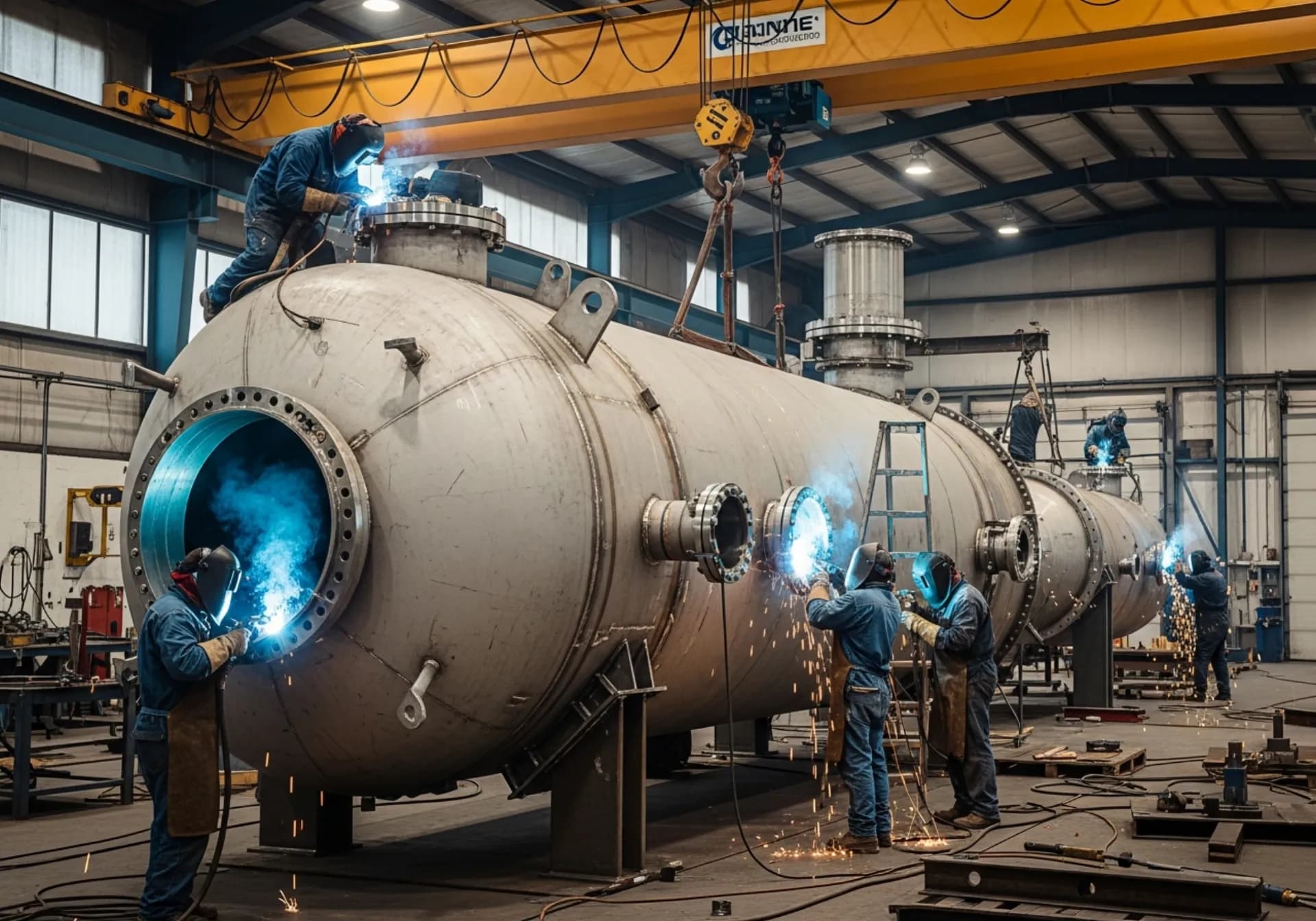
Structural fabrication and pressure vessel construction for new pollution control equipment is coordinated by Falcon as part of the overall project. Fully equipped fabrication capabilities produce the structural steel, vessels, tanks, stacks, and large-diameter ductwork required for pollution control equipment construction. ASME-certified welders fabricate pressure vessels per Section VIII of the ASME Boiler and Pressure Vessel Code. Structural steel is fabricated per AWS D1.1 Structural Welding Code. This approach lets Falcon Environmental Solutions deliver complete fabricated equipment without passing coordination costs to the client, keeping overhead low while maintaining full quality control over the finished product.
Site preparation and foundation work establishes the physical infrastructure that supports the new equipment. Pollution control equipment can be heavy and subject to significant wind, seismic, and thermal loads. Foundation design must account for equipment dead weight, operating weight (including media, liquid holdup, and refractory), wind loads per ASCE 7, seismic loads per the applicable building code, and thermal expansion forces. We coordinate foundation design with a licensed structural engineer and manage the civil construction through qualified concrete contractors. Equipment is set by crane with rigging plans developed for the specific lift requirements.
Controls integration connects the new pollution control equipment to the facility's control system and, when appropriate, to our FalconWatch remote monitoring platform. Controls work for new unit construction projects is coordinated through our industry partners Creekmist Controls and MAK Solutions, who provide PLC programming, HMI development, and safety system integration for the new equipment. The control system typically includes a burner management system (BMS) per NFPA 86, process temperature control, airflow control, safety interlock logic, and alarm management. Falcon manages the overall project and coordinates between the controls partners and the mechanical installation team to ensure seamless integration.
Commissioning and startup is the final phase of every new unit construction project. Our commissioning process follows a structured sequence: mechanical completion verification, control system checkout, safety interlock testing, cold startup (airflow verification without combustion), warm startup (burner lightoff and temperature ramp), performance testing at design conditions, and operator training. We do not consider the project complete until the equipment is operating at its design performance, all safety systems are verified functional, the operators are trained and comfortable, and the system is ready for the initial compliance source test.
Thermal oxidizer design follows EPA guidance for VOC and HAP destruction including residence time calculations, combustion temperature requirements, and mixing considerations. RTO thermal efficiency calculations follow heat recovery methodology with ceramic media properties (specific heat, void fraction, pressure drop correlations). Scrubber design follows EPA APTI Course 415 methodology for packed tower design including mass transfer calculations, pressure drop (Eckert correlation), and flooding velocity determination. Flare design follows API 521 for relief load sizing and API 537 for flare details. Structural steel per AISC Steel Construction Manual and AWS D1.1. Pressure vessels per ASME BPVC Section VIII Division 1. Foundation design per ACI 318 with loads per ASCE 7. All equipment and materials specified per applicable ASTM standards.
Contact us to discuss your new unit construction requirements and get a tailored proposal for your facility.
Request a QuoteSystem Upgrades
Piping, ductwork, valve, burner, refractory, damper, fan, and insulation upgrades for thermal oxidizers, RTOs, scrubbers, and other pollution control equipment.
Burner Tuning
Combustion optimization for thermal oxidizers, process heaters, and boilers, delivering lower NOx emissions, reduced fuel consumption, and reliable flame stability across all major burner platforms.
Environmental Consulting & Permit Support
Air permit applications, emissions inventory, regulatory compliance strategy, and agency coordination for facilities operating pollution control equipment under EPA, TCEQ, and state regulatory programs.
Engineered for Reliability. Built for the Field.
Why industrial facilities nationwide choose Falcon Environmental Solutions for new unit construction services.
One company manages the entire project from engineering through commissioning. There are no gaps between engineering, fabrication, installation, controls, and startup because Falcon coordinates every discipline under one project management umbrella.
We select the right control technology for your specific application based on the pollutants, concentrations, flow rates, and regulatory requirements involved. The equipment is engineered for your process, not adapted from a generic catalog design.
Creekmist Controls and MAK Solutions for controls integration. Our established partners deliver consistent quality because we work together regularly and hold each other to high standards.
Every new unit is designed to meet the emission limits and destruction efficiency requirements in your air permit with appropriate performance margin. The equipment is ready for its initial compliance source test from day one of operation.
Turnkey project management with defined milestones, regular progress reporting, and proactive issue resolution keeps the project on schedule and on budget. Problems are identified and addressed early before they cascade into delays and cost overruns.
The project is not complete until operators are trained, documentation is delivered, spare parts are on site, and the equipment is running at design performance. Our commissioning process ensures operational readiness from the first day.
Our new unit construction services support a wide range of industrial and environmental applications.
New thermal oxidizer and RTO construction for printing, coating, painting, and adhesive operations that generate high-volume VOC streams requiring destruction efficiencies of 95-99%+ to meet air permit limits.
Catalytic oxidizer and thermal oxidizer systems for facilities emitting hazardous air pollutants (HAPs) subject to MACT/NESHAP standards with stringent destruction efficiency and continuous compliance monitoring requirements.
Packed bed scrubber and venturi scrubber systems for acid gas control (HCl, SO2, HF) in semiconductor, metal finishing, chemical manufacturing, and waste treatment applications with multi-stage treatment trains for high removal efficiency.
Elevated and ground flare systems for petroleum refining, petrochemical, and chemical manufacturing facilities requiring reliable waste gas disposal for both routine process vents and emergency pressure relief scenarios per API 521 and 40 CFR 60.18.
Engineered replacement of existing thermal oxidizers, scrubbers, or catalytic oxidizers that have reached end of life, with modern equipment designed for current regulatory requirements, improved energy efficiency, and reduced maintenance costs.
Falcon Environmental Solutions delivers new unit construction services engineered for reliability, compliance, and long-term operational value. Contact us to discuss your project requirements and receive a detailed engineering proposal.