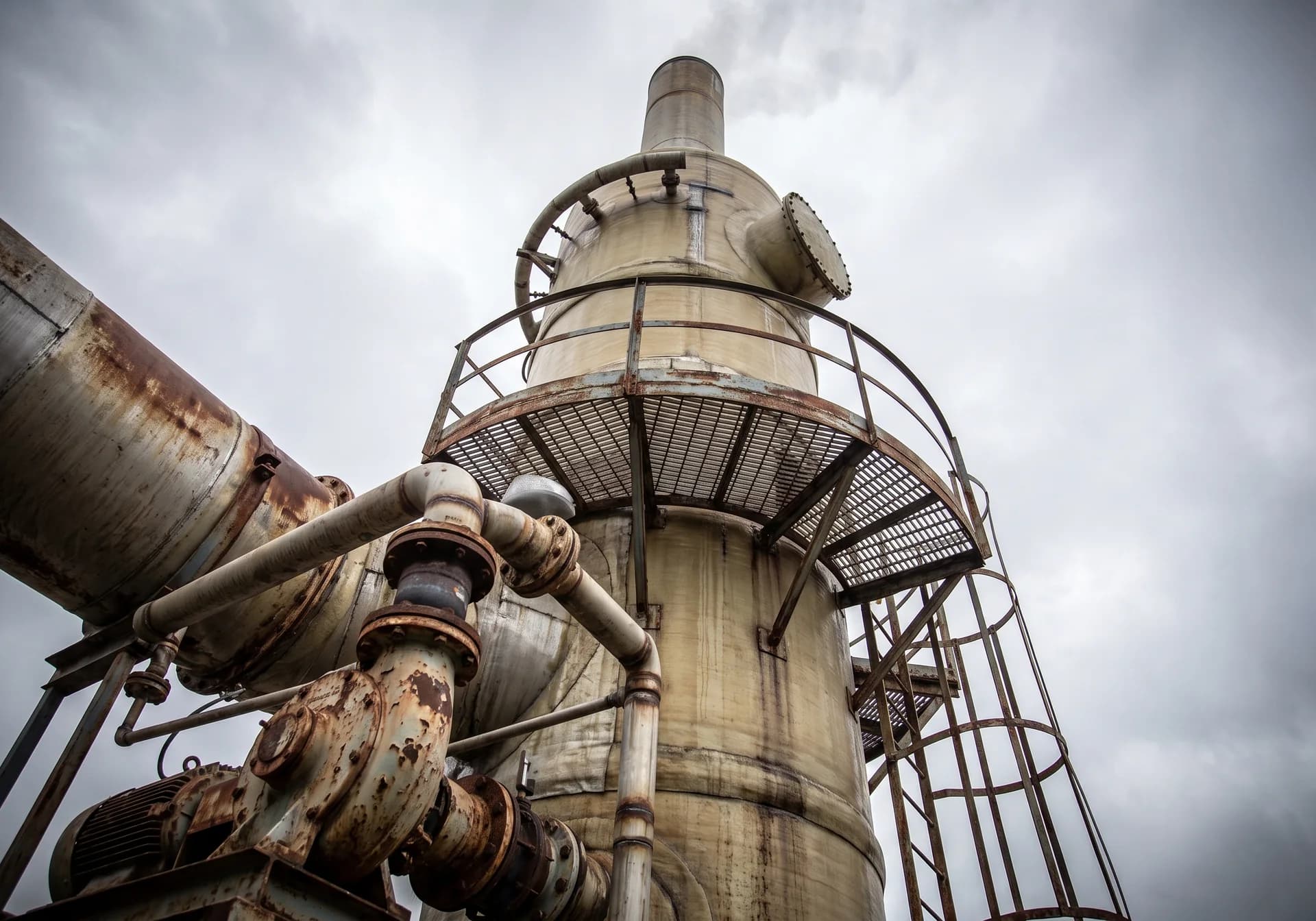
Onsite tuning of equipment during EPA testing. Our team will work to ensure that your source testing is successful and meets your needed requirements. Our understanding of how unit tuning and operation can affect your units DRE, NOx and CO are invaluable when pricing compliance. We handle coordination, preparation, equipment verification, and data review so your source test runs smoothly and produces defensible results.
Source testing, also called stack testing or emissions testing, is the definitive method for demonstrating that your pollution control equipment meets its permitted emission limits and destruction efficiency requirements. Regulatory agencies require periodic source tests for thermal oxidizers, catalytic oxidizers, scrubbers, and other control devices to verify ongoing compliance. Insurance carriers may require performance demonstrations. Permit applications for new or modified equipment often require initial compliance testing within 180 days of startup. The results of a source test are reported to the regulatory agency and become part of your facility's permanent compliance record. Getting it right the first time matters.
Falcon Environmental Solutions provides source testing support services that ensure your facility is fully prepared for the test, the test is conducted under proper operating conditions, and the results accurately represent your equipment's performance. We do not operate the source testing equipment ourselves. Source testing is performed by independent third-party testing firms that are accredited and certified to conduct EPA reference method testing. Our role is to prepare your facility and your pollution control equipment for the test, coordinate between your operations team and the testing firm, verify that the test is conducted under representative conditions, and review the test report for accuracy and completeness before it is submitted to the regulatory agency.
Stack test coordination begins weeks before the testing firm arrives on site. We review the test protocol to verify that the correct EPA reference methods are specified for each pollutant. Method 1 determines the appropriate sampling locations and traverse points in the stack. Method 2 measures stack gas velocity and volumetric flow rate. Method 5 captures particulate matter on a filter. Method 25A measures total gaseous organic concentration using a flame ionization detector (FID). Method 9 evaluates visible emissions (opacity). Other methods address specific pollutants: Method 7E for NOx, Method 10 for CO, Method 18 for individual VOC species, Method 26A for hydrogen halides, and many more. We verify that the test protocol matches your permit requirements, your equipment configuration, and the operating conditions under which the test will be conducted.
Test port installation and access platform construction are physical preparations that must be in place before the testing firm arrives. EPA reference methods require sampling ports at specific locations in the stack or duct, determined by Method 1 criteria for upstream and downstream distances from flow disturbances. The ports must be the correct size (typically 4-inch diameter for standard particulate and gaseous sampling), at the correct orientation, and equipped with proper caps or plugs when not in use. Access platforms must provide safe, stable working surfaces for the test crew and their equipment at each sampling location. Falcon Environmental Solutions specifies, procures, and installs test ports and access platforms that meet EPA requirements and OSHA fall protection standards. Getting the test ports right before the testing firm arrives prevents costly delays and schedule disruptions.
Pre-test equipment verification ensures that your pollution control equipment is operating at its rated performance before the source test begins. A source test conducted while the equipment is running below design conditions will produce results that do not represent the equipment's true capability. Before the test, our technicians verify burner operation and combustion parameters, process inlet flow rates and temperatures, control device operating temperatures, fan speeds and system airflow, and all relevant monitoring equipment (CEMS, temperature recorders, flow meters). We confirm that the process is operating at the production rate specified in the test protocol, which is typically the maximum rated capacity or the maximum expected operating rate. Any deficiencies identified during pre-test verification are corrected before the test proceeds.
Test day support involves our technicians being on site during the actual source test to monitor pollution control equipment operation, answer the testing firm's questions about the equipment and process, and ensure that operating conditions remain stable and representative throughout the test runs. Source tests typically consist of three test runs, each lasting one to four hours depending on the method. During this time, the process must operate steadily at the conditions specified in the test protocol. Any deviation from normal operation during a test run can invalidate the results for that run, requiring an additional run and extending the test schedule. Our on-site presence during the test helps prevent these disruptions.
Data review and report support ensure that the source test results are accurate, properly calculated, and presented in a format that satisfies the regulatory agency. After the testing firm completes their laboratory analysis and calculations, they produce a draft test report. Falcon Environmental Solutions reviews this draft for calculation errors, unit conversion mistakes, data transcription errors, and consistency between field data sheets and reported results. We verify that the emission rates and destruction efficiency values are correctly calculated using the measured data and the appropriate EPA reference method equations. We check that the report includes all required information: test dates, operating conditions, sampling data, analytical results, quality assurance data, and a clear statement of compliance or non-compliance. Our review catches errors that could lead to questions from the regulatory agency, delays in report acceptance, or incorrect compliance determinations.
CEMS correlation testing support addresses the relationship between continuous emissions monitoring systems (CEMS) and EPA reference method measurements. Facilities that operate CEMS are required by 40 CFR Part 60 or Part 75 to conduct periodic Relative Accuracy Test Audits (RATAs) that compare CEMS measurements to concurrent EPA reference method measurements. The CEMS must demonstrate that its readings correlate with the reference method results within specified accuracy criteria. Falcon Environmental Solutions supports CEMS correlation testing by verifying CEMS calibration before the RATA, ensuring proper reference method sampling, and reviewing the correlation data to identify any issues that might cause the RATA to fail. If the CEMS does not meet the accuracy criteria, we work with the CEMS vendor and the testing firm to identify the cause and implement corrective actions.
Failed source test response is a critical service that we provide when test results show non-compliance. A failed source test triggers a cascade of regulatory consequences: deviation reporting, possible enforcement action, and the requirement to retest after corrective actions are completed. Falcon Environmental Solutions responds to failed source tests by analyzing the test data to determine the root cause of the failure, implementing corrective actions on the pollution control equipment (burner tuning, temperature optimization, airflow adjustments, media or catalyst replacement), and coordinating the retest to demonstrate compliance. Our hands-on knowledge of pollution control equipment allows us to diagnose and correct performance issues quickly, minimizing the time your facility operates in a non-compliant status.
Source test scheduling and regulatory notification are administrative tasks that we manage on your behalf. Most regulatory agencies require advance notification of source testing, typically 30 to 60 days before the scheduled test date. The notification must include the test date, the methods to be used, the operating conditions during the test, and the testing firm's qualifications. Falcon Environmental Solutions prepares and submits these notifications, coordinates the schedule between your operations team, the testing firm, and the regulatory agency, and manages any schedule changes that arise due to weather, equipment issues, or process conditions.
Source testing support references EPA reference methods as published in 40 CFR Part 60, Appendix A (Methods 1 through 29), and 40 CFR Part 63, Appendix A (Methods 301 through 326). Test port specifications follow EPA Method 1 criteria for sampling location selection and Method 1A for small stacks and ducts. Velocity and flow rate measurements follow Method 2 (S-type pitot) or Method 2F/2G (3-dimensional probes for cyclonic or non-axial flow). Particulate matter sampling follows Method 5 with appropriate modifications (Method 5B, 5D, 5E, 5F, 5G, 5H, 5I) for specific source categories. Gaseous organic measurements use Method 25A (FID), Method 18 (GC), or Method 320 (FTIR) depending on the pollutants of interest. CEMS correlation testing follows 40 CFR Part 60 Performance Specification 2 (SO2 and NOx), PS 3 (O2 and CO2), PS 4A (CO), and Quality Assurance Procedure 1 for ongoing quality assurance.
Contact us to discuss your source testing support requirements and get a tailored proposal for your facility.
Request a QuoteEnvironmental Consulting & Permit Support
Air permit applications, emissions inventory, regulatory compliance strategy, and agency coordination for facilities operating pollution control equipment under EPA, TCEQ, and state regulatory programs.
Burner Tuning
Combustion optimization for thermal oxidizers, process heaters, and boilers, delivering lower NOx emissions, reduced fuel consumption, and reliable flame stability across all major burner platforms.
FalconWatch Remote Monitoring
24/7 remote monitoring platform for pollution control equipment, developed by our industry partner Creekmist Controls, providing real-time equipment status, compliance data logging, and secure client portal access.
Engineered for Reliability. Built for the Field.
Why industrial facilities nationwide choose Falcon Environmental Solutions for source testing support services.
Thorough preparation, equipment verification, and on-site support maximize the probability that your source test demonstrates compliance on the first attempt. Failed tests are expensive, disruptive, and create regulatory complications that proper preparation avoids.
Our pre-test verification and data review ensure that the source test results accurately represent your equipment's performance and can withstand regulatory scrutiny. Clean, accurate test reports are accepted faster and generate fewer agency follow-up questions.
Source testing firms charge by the day. Delays caused by improper test ports, equipment issues, or unstable operating conditions extend the test schedule and increase costs. Our preparation eliminates these common causes of delay.
Pre-test equipment verification often reveals performance issues that can be corrected before the test. Burner tuning, airflow adjustments, and temperature optimization performed in advance ensure your equipment demonstrates its best possible performance during the test.
If a test does not demonstrate compliance, our technicians can diagnose the root cause and implement corrective actions immediately because we know pollution control equipment at the component level. Fast corrective action minimizes regulatory exposure.
We handle notifications, schedule coordination, and post-test submissions with the regulatory agency on your behalf, ensuring all deadlines and documentation requirements are met without burdening your internal staff.
Our source testing support services support a wide range of industrial and environmental applications.
Source testing support for thermal oxidizers, RTOs, and catalytic oxidizers demonstrating VOC and HAP destruction rate efficiency (DRE) using EPA Method 25A (total gaseous organics) and Method 18 (individual VOC species) at the inlet and outlet.
Testing support for wet scrubbers, dry scrubbers, and packed bed scrubbers demonstrating particulate removal efficiency (Method 5), acid gas removal (Method 26A), or other pollutant-specific performance requirements.
Source test support for Boiler MACT (40 CFR 63 Subpart DDDDD) compliance demonstrations including PM, CO, and mercury testing, and for NOx compliance demonstrations under state-specific combustion equipment rules.
Support for quarterly and annual RATA testing required by 40 CFR Part 60 and Part 75 for facilities operating CEMS, including pre-RATA calibration verification and post-RATA data analysis.
Complete source testing coordination for newly constructed or modified pollution control equipment that must demonstrate compliance within 180 days of startup per permit conditions, including test protocol development, agency notification, and test execution support.
Falcon Environmental Solutions delivers source testing support services engineered for reliability, compliance, and long-term operational value. Contact us to discuss your project requirements and receive a detailed engineering proposal.