Industrial automation, PLC programming, SCADA systems, and environmental compliance solutions for Charlotte and the greater North Carolina region.
Charlotte and the surrounding Piedmont region of North Carolina represent one of the fastest-growing manufacturing markets in the southeastern United States, and the pollution control equipment serving this region reflects a distinctive industrial mix that differs significantly from the petrochemical corridors of the Gulf Coast or the heavy manufacturing of the Midwest. The I-85 corridor from Charlotte through Gastonia and Hickory into the western foothills has attracted hundreds of manufacturing operations spanning gas turbine production, tire manufacturing, automotive parts coating, plastics processing, furniture finishing, and textile dyeing and finishing. Each of these sectors generates VOC, particulate, or acid gas emissions that require pollution control equipment designed for the specific emission profile of the application.
Duke Energy's headquarters in Charlotte and its generation fleet across the Carolinas make the Charlotte region a center for power generation pollution control technology. Duke operates nuclear stations, natural gas combined cycle plants, and legacy coal stations in various stages of retirement, and the utility's coal ash management program has created extensive groundwater treatment and monitoring requirements at plant sites across the region. The selective catalytic reduction systems, flue gas desulfurization scrubbers, and activated carbon injection systems at Duke's fossil fuel stations represent large-scale pollution control installations that require ongoing catalyst management, scrubber maintenance, and performance monitoring.
The region's legacy textile and furniture industries, while significantly smaller than their peak, continue to operate dyeing, finishing, and coating facilities that produce VOC and particulate emissions controlled by thermal oxidizers, catalytic oxidizers, and fabric filter collectors. Modern technical textile production at companies like Unifi (maker of REPREVE recycled fiber) adds new emission control requirements. The Charlotte metro area's growth has also brought pharmaceutical, food processing, and specialty chemical operations that add their own pollution control equipment service demands. The diversity of emission sources and control technologies across the Piedmont creates a market that requires a pollution control service provider with broad equipment knowledge and regulatory familiarity across multiple industrial sectors.
Contact us to discuss your industrial automation and environmental compliance requirements for your Charlotte-area facility.
Request a QuoteThe major industrial sectors in the Charlotte region that depend on reliable process control and environmental monitoring.
Duke Energy operates selective catalytic reduction (SCR) systems on natural gas combined cycle plants throughout the Carolinas, with catalyst beds that reduce NOx emissions from gas turbine exhaust. The SCR catalyst at gas-fired plants faces a different degradation profile than coal-fired plant catalyst, with primary deactivation mechanisms including ammonia salt formation at low loads and oxidation catalyst sintering at high temperatures. Legacy coal station pollution control trains include SCR systems, electrostatic precipitators, wet flue gas desulfurization (FGD) scrubbers, and activated carbon injection systems for mercury control, some of which continue to operate during facility transitions. Duke's coal ash remediation program at sites including Riverbend (Mount Holly) and Allen (Belmont) requires groundwater extraction and treatment systems with air stripping, carbon adsorption, and chemical oxidation components that have their own emission control needs. Falcon Environmental Solutions provides SCR catalyst management, FGD scrubber maintenance, and pollution control equipment inspection and service across the energy generation sector in the Charlotte region.
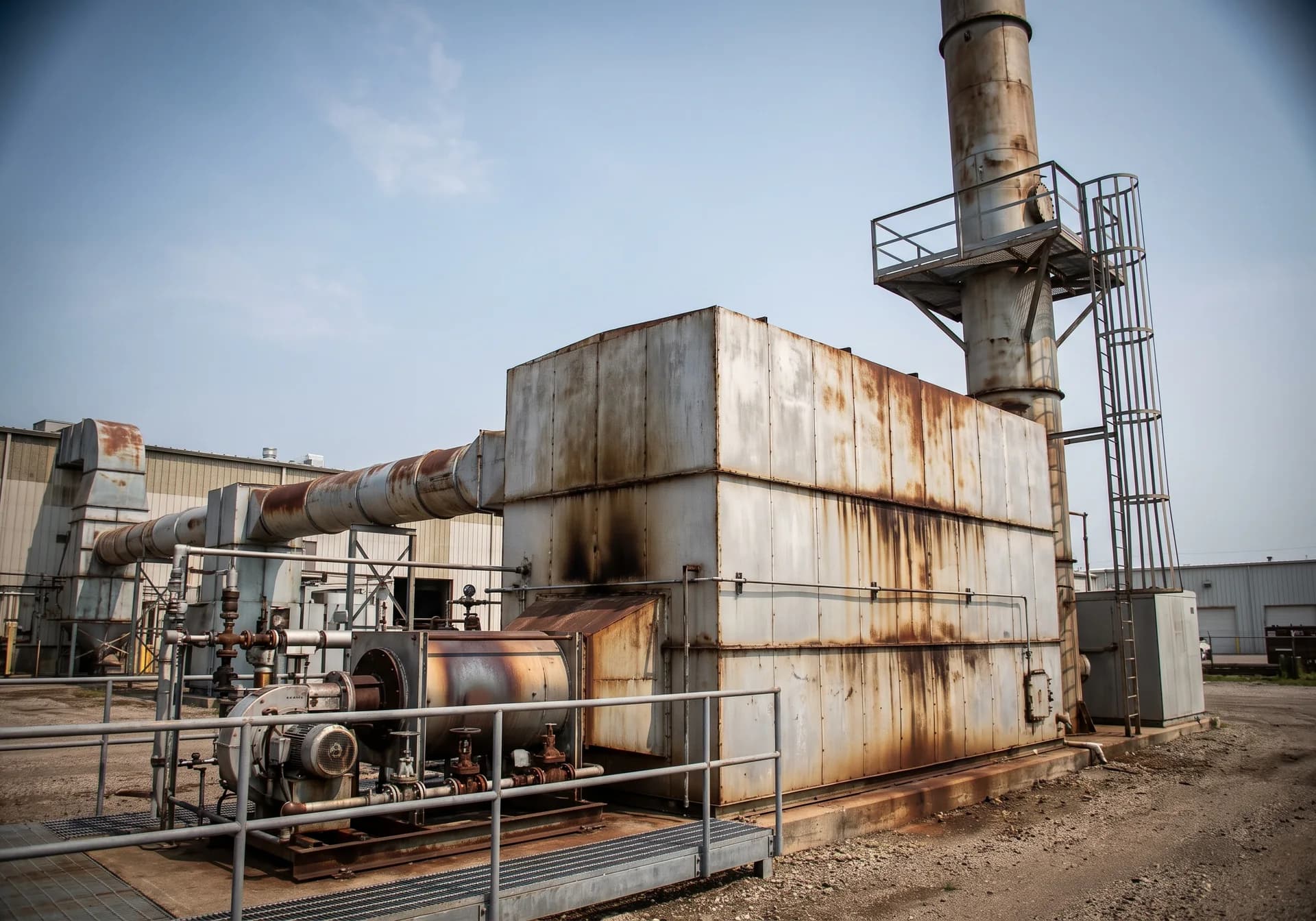
Charlotte's advanced manufacturing base generates significant VOC emissions from coating, painting, and finishing operations across multiple sectors. Siemens Energy's gas turbine facility applies protective coatings to turbine components. Continental Tire's manufacturing plant uses rubber processing chemicals and applies tire markings that generate VOC emissions. Automotive parts suppliers throughout the I-85 corridor operate paint lines and coating applications with thermal oxidizers or catalytic oxidizers on exhaust systems. Furniture manufacturers in the Hickory area, while reduced from historical levels, still operate finishing lines where stain, lacquer, and topcoat application produces concentrated VOC exhaust streams. The thermal oxidizers and catalytic oxidizers at these facilities range from modern, well-instrumented units at large manufacturers to older equipment at smaller operations that may lack current controls and monitoring capability. Falcon provides burner tuning, catalyst management, NFPA 86 safety inspections, and equipment assessment services across the manufacturing coating sector, with system upgrade recommendations when existing equipment cannot reliably meet NC DEQ permit requirements.
The Piedmont's textile legacy persists in a smaller but more technologically advanced form, with dye houses, finishing operations, and technical fabric producers operating heat set ovens, tenter frames, and coating lines that generate VOC and particulate emissions from fabric processing. Tenter frame exhaust contains a complex mixture of oils, waxes, lubricants, and fabric finishing chemicals that vary with the product being processed. Thermal oxidizers on tenter frame exhaust must handle high-moisture, variable-composition streams that can include condensable organics that foul ductwork and heat exchange surfaces upstream of the combustion chamber. Catalytic oxidizers on textile finishing exhaust face catalyst contamination from silicone-based fabric softeners and other finish chemicals that can permanently deactivate catalyst beds. Falcon provides specialized service for textile industry pollution control equipment, including inlet ductwork cleaning, condensable organic management, burner tuning for high-moisture exhaust streams, and catalyst evaluation for textile-specific contamination patterns.
The Charlotte region's food and beverage manufacturing sector operates thermal oxidizers, catalytic oxidizers, and biofilter systems for VOC and odor control on cooking, roasting, frying, and rendering exhaust. Snyder's-Lance production facilities, bakery operations, and poultry processing plants in the broader Piedmont region generate organic compound emissions that require destruction to meet NC DEQ air quality permits and prevent odor complaints from surrounding communities. Food processing exhaust carries grease, particulate, and condensable organic compounds that foul pollution control equipment and reduce efficiency. RTO ceramic media beds, catalytic oxidizer catalyst, and biofilter media all degrade faster in food processing applications than in clean solvent-vapor applications. Ammonia refrigeration systems at larger food facilities include emergency scrubber systems that must be maintained in operational readiness. Falcon provides maintenance for food industry pollution control equipment with attention to the fouling and contamination challenges specific to food processing exhaust, including media and catalyst cleaning programs, grease management system service, and emergency scrubber functional testing.
Charlotte's growing pharmaceutical and specialty chemical sector operates catalytic oxidizers, thermal oxidizers, and scrubber systems on process exhaust from synthesis, formulation, and packaging operations. These facilities often operate at smaller scale than Gulf Coast chemical plants but face the same fundamental pollution control challenges of managing variable-composition solvent exhaust, maintaining destruction efficiency, and documenting compliance. Specialty chemical producers in the region manufacture coatings, adhesives, cleaning products, and industrial chemicals with batch processing that creates cyclic emission patterns. The pollution control equipment at these facilities must handle the full range of operating conditions from peak emission loading during active production to minimal loading during changeovers and cleaning. Falcon provides comprehensive pollution control service for pharmaceutical and specialty chemical operations, including catalytic oxidizer catalyst management, thermal oxidizer burner tuning for variable-load applications, scrubber maintenance, and compliance documentation support for NC DEQ permit requirements.
The compliance landscape for industrial operations in the Charlotte region.
North Carolina industrial facilities operate under the North Carolina Department of Environmental Quality (NC DEQ), which administers air quality permits through its Division of Air Quality (DAQ) under NC Administrative Code Title 15A, Chapters 2D and 2Q. The Charlotte region is currently in attainment for all NAAQS criteria pollutants, which simplifies major source permitting compared to nonattainment areas but still requires Best Available Control Technology (BACT) analysis for Prevention of Significant Deterioration (PSD) permits on new major sources. Thermal oxidizers and catalytic oxidizers must demonstrate destruction efficiency through source testing, with continuous parametric monitoring (typically combustion chamber temperature) as the compliance indicator between tests. NC DEQ's coal ash management oversight under the Coal Ash Management Act (CAMA) creates extensive monitoring requirements at Duke Energy remediation sites. NFPA 86 applies to thermal oxidizers and RTOs. NC DEQ has been increasing attention to emerging contaminant issues including PFAS, which may affect permits for certain industrial operations. The Charlotte region's business-friendly regulatory reputation does not mean lax enforcement. NC DAQ conducts regular compliance inspections and expects well-documented pollution control equipment maintenance records and source test results. Facilities that maintain professional service records and consistent compliance documentation benefit from constructive regulatory relationships.
Engineered for Reliability. Built for the Field.
Our engineering services tailored to the specific needs of Charlotte-area industrial facilities.
Falcon Environmental Solutions provides Charlotte and Piedmont region manufacturers with pollution control equipment service spanning the diverse range of technologies operating across this growing industrial market. Burner tuning and combustion optimization address thermal oxidizers and catalytic oxidizers at manufacturing coating operations, textile finishing facilities, food processing plants, and specialty chemical producers. SCR catalyst management serves Duke Energy generation facilities and other large combustion sources.
NFPA 86 safety inspections cover all combustion-based pollution control equipment. Scrubber maintenance programs address FGD systems at power plants, acid gas scrubbers at chemical operations, and emergency ammonia scrubbers at food processing cold storage facilities. Environmental consulting helps Charlotte-area manufacturers navigate NC DEQ permitting for new pollution control equipment installations and modifications to existing systems.
Equipment condition assessments help facility managers make informed refurbishment-versus-replacement decisions on aging pollution control equipment. System upgrades and new construction services include thermal oxidizer installations, scrubber modifications, and controls modernization performed in partnership with Creekmist Controls and MAK Solutions. The FalconWatch monitoring platform, developed by partner Creekmist Controls, provides continuous remote access to combustion temperatures, scrubber parameters, and other compliance-critical operating data for facilities across the Piedmont region.
Charlotte's industrial market is growing rapidly and attracting manufacturers who are building in North Carolina for the first time. These new operations discover a regulatory environment that, while generally constructive, has its own permitting processes, inspection expectations, and compliance documentation standards that differ from the states they previously operated in. Having a local pollution control service provider who understands NC DEQ's Division of Air Quality permitting workflow, knows the inspection patterns, and can help new facilities establish compliance programs from day one provides significant value.
The region's mix of large energy sector pollution control installations, mid-size manufacturing oxidizer systems, and smaller specialty chemical and food processing equipment requires a service provider with breadth across equipment types and industry applications. The Piedmont climate, with hot humid summers and occasional ice storms that can affect outdoor equipment, adds regional considerations for pollution control system maintenance. Falcon Environmental Solutions provides Charlotte-area clients with the regulatory knowledge, equipment expertise, and local service presence that this growing market requires.
Falcon Environmental Solutions delivers industrial automation and environmental compliance services engineered for the Charlotte market. Contact us to discuss your project requirements and receive a detailed engineering proposal.
Falcon Environmental Solutions provides industrial automation services across the country.